Essay Writing Tips to Write Better Essays With Confidence
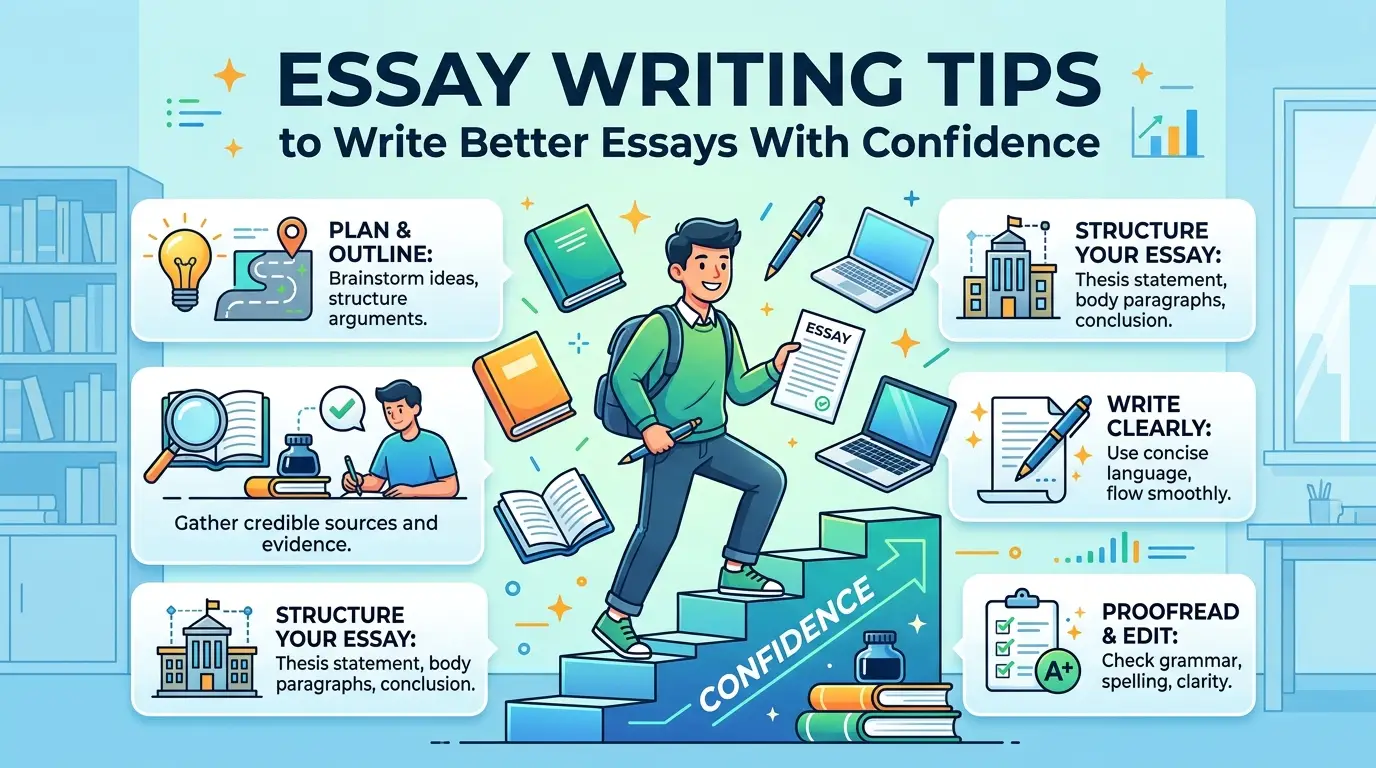
Writing a strong essay is more than putting words on a page. It is about developing a clear idea, organizing your thoughts, supporting your argument, and guiding your reader smoothly from the introduction to the conclusion. Whether you are writing a school assignment, college paper, scholarship essay, research essay, or personal essay, the right essay writing tips can make the process easier and the final result much stronger. These 149 essay writing tips are designed to help you plan, write, edit, and improve your essays while making your writing clearer, more natural, persuasive, and engaging.
Essay Writing Tips for Getting Started
“Understand the assignment before you begin.” Read the prompt carefully and identify exactly what your teacher, professor, editor, or reader expects. Pay attention to command words such as analyze, compare, explain, evaluate, discuss, or argue because each one requires a different approach.
“Choose a topic you can actually develop.” A topic may sound interesting but still be too broad, too narrow, or difficult to support. Pick a subject that gives you enough room to explore meaningful ideas and find relevant evidence.
“Start with a simple question.” Turning your topic into a question can make essay writing much easier because it gives your research and argument a clear direction.
“Know your audience.” Think about who will read your essay and what they already know. Your vocabulary, examples, explanations, and level of detail should match your intended reader.
“Identify the purpose of your essay.” Decide whether your goal is to inform, persuade, analyze, compare, describe, explain, or entertain. Knowing the purpose helps you make better writing decisions.
“Break the prompt into smaller tasks.” If an assignment contains several questions, separate them before writing. This prevents you from answering one part thoroughly while accidentally ignoring another.
“Set a realistic writing goal.” Instead of telling yourself to finish an entire essay immediately, divide the work into research, outlining, drafting, revising, and proofreading.
“Give yourself more time than you think you need.” Last-minute writing often produces weak arguments, rushed research, and careless grammar mistakes. Extra time gives your ideas room to improve.
“Read successful essays.” Studying well-written essays can help you recognize effective introductions, transitions, evidence, paragraph structures, and conclusions.
“Keep your first draft imperfect.” Your first draft does not need to sound brilliant. Its main purpose is to get your ideas onto the page so you can improve them later.
Essay Writing Tips for Research
“Research before making strong claims.” If your essay depends on facts, statistics, historical events, or expert opinions, verify your information before presenting it as evidence.
“Use reliable sources.” Academic journals, books, reputable websites, government publications, and credible organizations are generally stronger sources than random online posts.
“Search with specific keywords.” Instead of searching for a huge topic, combine your main subject with terms such as causes, effects, research, statistics, history, criticism, or examples.
“Take useful notes.” Record important facts, quotations, ideas, and source information while researching so you do not have to search for everything again later.
“Separate facts from opinions.” Knowing whether information is evidence, interpretation, or personal opinion helps you build a more accurate argument.
“Look for different perspectives.” Research becomes stronger when you understand opposing views rather than collecting only information that agrees with your position.
“Check the date of your sources.” Recent sources may be essential for topics involving technology, science, politics, economics, or current events.
“Compare information across sources.” If several credible sources support the same point, your argument becomes more convincing.
“Do not depend on one source.” A single source can limit your understanding and make your essay appear poorly researched.
“Record citations immediately.” Write down author names, titles, publication dates, and links or publication details as you research to make citation work easier later.
Essay Writing Tips for Developing Ideas
“Choose one central argument.” A strong essay usually has one main idea that holds the entire discussion together.
“Create a working thesis.” Your thesis does not have to be perfect at the beginning. Start with a basic position and refine it as you learn more.
“Ask why your argument matters.” Understanding the significance of your topic can help you move beyond simple description and create deeper analysis.
“Think about cause and effect.” Asking what caused something and what resulted from it can reveal useful connections for an analytical essay.
“Look for patterns.” Repeated themes, similarities, differences, and trends can provide strong material for developing an argument.
“Challenge your first assumption.” Sometimes the most interesting essay ideas appear when you question what you initially believed about the topic.
“Consider the opposing argument.” Ask what someone who disagrees with you might say and prepare a reasonable response.
“Use specific examples.” General statements are difficult to remember. Concrete examples make abstract ideas easier to understand.
“Explain your reasoning.” Do not assume your reader will automatically understand why your evidence supports your claim.
“Keep asking deeper questions.” Questions such as why, how, so what, and what does this reveal can turn a basic essay into a thoughtful one.
Essay Writing Tips for Creating a Thesis
“Make your thesis clear.” Your reader should quickly understand the main position or idea your essay will develop.
“Avoid an overly broad thesis.” A statement covering an enormous subject is difficult to prove within a normal essay.
“Make your thesis arguable when appropriate.” Persuasive and analytical essays benefit from a position that reasonable readers could debate.
“Match your thesis to the assignment.” If the prompt asks you to compare two subjects, your thesis should establish the meaningful comparison rather than discuss unrelated information.
“Do not hide your main idea.” A reader should not have to finish several paragraphs before discovering what your essay is actually arguing.
“Keep the thesis focused.” A focused thesis gives every paragraph a clear job.
“Revise your thesis after researching.” New evidence may change your understanding of the topic, so allow your thesis to evolve.
“Avoid unnecessary complexity.” A sophisticated thesis can still be written in simple, direct language.
“Make every body paragraph support the thesis.” If a paragraph does not contribute to your central argument, consider removing or rewriting it.
“Use the thesis as your compass.” Whenever you are unsure whether information belongs in the essay, ask whether it supports the main argument.
Essay Writing Tips for Planning and Outlining
“Create an outline before drafting.” A simple outline can save significant time because it gives your ideas a logical order.
“Write your main points first.” Identify the major arguments you want to make before deciding what evidence belongs beneath them.
“Give each paragraph one main purpose.” Paragraphs become easier to follow when each one develops a distinct idea.
“Arrange points logically.” You might organize ideas chronologically, from strongest to weakest, from cause to effect, or from general information to specific analysis.
“Put your strongest evidence where it matters.” Important evidence can make a greater impact when placed strategically rather than randomly.
“Plan your introduction.” Know what background, context, and thesis you want to include before beginning the body.
“Plan your conclusion.” Decide what your essay should leave the reader thinking about after the final paragraph.
“Allow your outline to change.” An outline is a guide, not a prison. If research reveals a better structure, adjust it.
“Estimate paragraph length.” Thinking about approximate paragraph sizes can help prevent one section from becoming much longer than the others.
“Remove unnecessary points from your outline.” More ideas do not automatically create a better essay. Choose the points that contribute most directly to your argument.
Essay Writing Tips for Writing Introductions
“Begin with relevance.” Your opening should quickly establish why the topic deserves the reader’s attention.
“Avoid empty introductions.” Statements such as broad claims about how important life, society, or the world is often add little value.
“Use an interesting question when appropriate.” A thoughtful question can create curiosity and encourage readers to continue.
“Provide necessary context.” Give readers enough background to understand the issue without turning the introduction into an entire history lesson.
“Introduce the topic naturally.” Avoid forcing your keyword or thesis into a sentence that sounds unnatural.
“End the introduction with a clear thesis.” The thesis often works best near the end of the opening section because it prepares the reader for the discussion ahead.
“Keep introductions focused.” A long introduction can delay the actual argument.
“Match your opening to your essay type.” A personal essay may begin with a moment or memory, while an academic essay may benefit from context or a research-based problem.
“Create curiosity without exaggerating.” You want readers interested, not misled by dramatic claims that your essay cannot support.
“Rewrite the introduction after finishing.” Once you understand your essay completely, you can often create a stronger opening.
Essay Writing Tips for Body Paragraphs
“Start paragraphs with clear topic sentences.” The topic sentence should tell readers what the paragraph is mainly about.
“Follow the claim with evidence.” After making a point, provide facts, examples, quotations, research, or reasoning that supports it.
“Explain every important piece of evidence.” Evidence becomes much more valuable when you explain what it demonstrates and why it matters.
“Connect paragraphs to the thesis.” Keep returning to your central argument throughout the essay.
“Use paragraph breaks wisely.” A new paragraph should signal a meaningful shift in idea, focus, or argument.
“Avoid overly short body paragraphs.” Extremely short paragraphs can make a developed argument feel fragmented.
“Avoid enormous paragraphs.” Very long paragraphs can overwhelm readers and often contain several ideas that should be separated.
“Use examples strategically.” Choose examples that directly strengthen your point instead of adding information simply to increase word count.
“Build ideas gradually.” Let each sentence prepare the reader for the next rather than jumping suddenly between unrelated claims.
“End paragraphs with purpose.” A final sentence can reinforce the point, interpret evidence, or create a natural bridge to the next paragraph.
Essay Writing Tips for Strong Evidence
“Use evidence that directly supports your claim.” Interesting information is not necessarily useful evidence.
“Prefer precise evidence.” Specific statistics, examples, observations, and documented facts are usually stronger than vague references.
“Introduce quotations.” Never drop a quotation into your essay without explaining where it comes from or why it matters.
“Keep quotations relevant.” A quotation should contribute something your own words cannot communicate as effectively.
“Paraphrase carefully.” Restate an idea in genuinely original language while preserving its meaning and crediting the source.
“Do not overload your essay with quotations.” Your essay should demonstrate your thinking, not simply reproduce the thinking of other writers.
“Interpret statistics.” Numbers alone may not communicate their significance. Explain what the statistics reveal about your argument.
“Use credible expert opinions.” Expert perspectives can strengthen complex arguments when they are relevant and properly cited.
“Question weak evidence.” Before using a source, consider its credibility, purpose, evidence, and potential bias.
“Connect evidence to analysis.” The strongest academic writing often follows a pattern of claim, evidence, explanation, and connection.
Essay Writing Tips for Essay Structure
“Use a logical progression.” Each section should feel like a natural step toward the conclusion.
“Keep related ideas together.” Separating closely connected points can make your argument harder to follow.
“Use transitions between ideas.” Words and phrases such as however, therefore, similarly, in contrast, and consequently can clarify relationships.
“Do not overuse transition words.” Too many transitions can make writing sound mechanical.
“Balance your sections.” Give important ideas enough space while avoiding unnecessary detail on minor points.
“Create a clear beginning, middle, and end.” Even complex academic essays benefit from a recognizable overall structure.
“Check paragraph order.” Try reading only your topic sentences to see whether the argument still makes sense.
“Remove structural repetition.” If several paragraphs follow exactly the same pattern, vary the presentation when appropriate.
“Use headings when suitable.” Longer essays may benefit from descriptive headings that help readers navigate major sections.
“Make the structure invisible but effective.” Readers should feel guided through the argument rather than noticing the mechanics of your organization.
Essay Writing Tips for Better Style
“Write clearly.” Simple, direct language is often more powerful than complicated wording.
“Vary sentence length.” A mixture of short, medium, and longer sentences creates a more natural rhythm.
“Use active voice when possible.” Active constructions often make writing more direct and energetic.
“Avoid unnecessary filler.” If a phrase does not add meaning, consider removing it.
“Choose precise words.” Replace vague terms such as things, stuff, good, or bad with language that communicates exactly what you mean.
“Use strong verbs.” Strong verbs can make sentences more concise and engaging.
“Avoid repeating the same phrase.” Repetition can make otherwise good writing sound mechanical.
“Write for the reader.” Every sentence should help the reader understand, evaluate, or appreciate your argument.
“Keep your tone appropriate.” Academic essays usually require a confident and professional tone without sounding unnatural.
“Let your personality appear through your ideas.” Formal writing does not have to sound lifeless. Thoughtful observations and original analysis can give your essay a distinctive voice.
Essay Writing Tips for Academic Writing
“Follow the required academic style.” Check whether your assignment requires APA, MLA, Chicago, Harvard, or another citation system.
“Use formal language when appropriate.” Avoid slang and overly casual expressions unless the assignment specifically invites them.
“Define specialized terms.” If your readers may not know a technical term, explain it when you first introduce it.
“Distinguish evidence from interpretation.” Make it clear when you are reporting information and when you are drawing your own conclusion.
“Avoid unsupported absolute statements.” Words such as always, never, everyone, and nobody can create claims that are difficult to defend.
“Use cautious language when necessary.” Terms such as may, can, often, suggests, and appears can make complex academic claims more accurate.
“Maintain consistency.” Keep your terminology, tense, formatting, and spelling consistent throughout the essay.
“Do not confuse complexity with intelligence.” An essay sounds more intelligent when its ideas are insightful, not when its sentences are unnecessarily complicated.
“Respect opposing viewpoints.” A fair discussion of alternative perspectives can make your own position more credible.
“Support original ideas.” If you introduce an unusual interpretation, explain the reasoning and evidence behind it.
Essay Writing Tips for Conclusions
“Do not simply repeat the introduction.” Your conclusion should synthesize the essay rather than copy earlier sentences.
“Return to the central argument.” Remind readers of the significance of what you have demonstrated.
“Synthesize your main points.” Show how the major ideas work together rather than listing them mechanically.
“Explain why the argument matters.” A strong conclusion can answer the important question, “Why should the reader care?”
“Leave the reader with a final thought.” A meaningful observation, implication, recommendation, or question can create a memorable ending.
“Avoid introducing major new evidence.” New arguments usually belong in the body rather than appearing unexpectedly in the conclusion.
“Keep the ending proportional.” A short essay does not need an enormous conclusion.
“Make the final sentence purposeful.” Your last sentence should feel like an ending, not a sentence that simply stops.
“Think beyond summary.” The conclusion is your opportunity to show the broader meaning of your discussion.
“Read the conclusion independently.” If it does not make sense without the body, strengthen its explanation and connection to the thesis.
Essay Writing Tips for Editing
“Take a break before editing.” Even a short pause can help you notice mistakes that were invisible while drafting.
“Edit for ideas first.” Check your argument, evidence, structure, and relevance before worrying about individual commas.
“Read your essay aloud.” Hearing your writing can reveal awkward phrases, repeated words, missing transitions, and overly long sentences.
“Check every paragraph.” Ask whether each paragraph has a clear purpose and contributes to the overall argument.
“Cut unnecessary sentences.” Removing weak material often improves an essay more than adding additional words.
“Replace vague language.” Look for places where your meaning could be more precise.
“Check transitions.” Make sure the movement from one paragraph to the next feels natural.
“Verify your evidence.” Confirm that quotations, statistics, names, dates, and factual claims are accurate.
“Check your thesis again.” Make sure the final essay actually proves or develops the thesis you wrote.
“Edit more than once.” Different editing passes allow you to focus on different problems without becoming overwhelmed.
Essay Writing Tips for Grammar and Proofreading
“Check subject-verb agreement.” Make sure singular and plural subjects match their verbs.
“Watch your verb tense.” Avoid switching between past and present tense without a reason.
“Check punctuation.” Commas, periods, semicolons, colons, apostrophes, and quotation marks can significantly affect clarity.
“Look for sentence fragments.” Every complete sentence should contain the necessary elements to express a complete thought.
“Fix run-on sentences.” Separate independent ideas when they become too long or incorrectly connected.
“Check spelling carefully.” Spell-checking tools are useful, but they cannot catch every incorrect word.
“Watch commonly confused words.” Pay attention to words such as affect and effect, their and they’re, your and you’re, and its and it’s.
“Check capitalization.” Proper nouns, titles, and sentence beginnings should follow the required capitalization rules.
“Proofread citations and references.” Formatting mistakes in citations can reduce the professionalism of an otherwise strong essay.
“Read backward during final proofreading.” Reading sentences from the end toward the beginning can help you focus on individual errors instead of becoming absorbed in the overall meaning.
Essay Writing Tips for Improving Efficiency
“Use focused writing sessions.” Short periods of concentrated work can be more productive than hours of distracted writing.
“Put your phone away.” Notifications can break your concentration and make writing take much longer.
“Use a simple writing environment.” Keep your workspace organized so you can focus on the essay rather than distractions.
“Write the easiest section first if necessary.” You do not always have to write from the first sentence to the last.
“Keep a list of ideas.” When a new thought appears while writing another section, record it instead of abandoning your current task.
“Use writing tools wisely.” Grammar checkers, dictionaries, citation tools, and spelling tools can assist you, but you should remain responsible for the final work.
“Set a word-count target.” A reasonable target can make a large assignment feel more manageable.
“Do not chase the perfect sentence.” Sometimes progress matters more during drafting than perfection.
“Save your work frequently.” Protect your effort by keeping reliable copies of important drafts.
“Finish with time to spare.” A final review often turns a good essay into a much stronger one.
Essay Writing Tips for Better Essays
“Read every sentence critically.” Ask whether it is clear, necessary, and connected to your purpose.
“Make your argument easy to find.” Strong writing should not force readers to search for your position.
“Prefer depth over empty length.” A thoughtful explanation is more valuable than several sentences added simply to reach a word count.
“Use original analysis.” Your interpretation is what transforms collected information into an actual essay.
“Think about the reader’s questions.” Anticipate what readers may wonder and answer those questions within the essay.
“Look for missing explanations.” If a paragraph jumps from evidence to conclusion, add the reasoning that connects them.
“Remove irrelevant information.” Interesting facts can weaken an essay if they distract from the main argument.
“Compare your essay with the rubric.” If your teacher provided grading criteria, use them as an editing checklist.
“Ask someone else to read it.” A fresh reader can identify unclear sections that you have become too familiar with to notice.
“Be willing to rewrite.” Sometimes the best improvement is not correcting sentences but rebuilding a weak section from the ground up.
Essay Writing Tips for Confidence and Creativity
“Trust your preparation.” Good research and planning give you a foundation for writing with confidence.
“Do not be afraid of your own voice.” Academic writing can remain professional while still sounding natural.
“Experiment during drafting.” Try different openings, structures, examples, or arguments before deciding which version works best.
“Use memorable examples.” A well-chosen example can make a complicated argument much easier to understand.
“Make connections others may overlook.” Original connections often create the most interesting essay ideas.
“Turn mistakes into learning opportunities.” Every weak draft teaches you something about your writing process.
“Keep improving your vocabulary naturally.” Read widely and notice how skilled writers express complex ideas without unnecessary complexity.
“Study feedback carefully.” Instead of viewing corrections as criticism, look for patterns that can improve your future essays.
“Build your own editing checklist.” Over time, you will discover the grammar, structure, and style mistakes you make most often.
“Remember that strong writing is developed.” Great essays rarely appear perfectly formed on the first attempt. They become strong through thinking, drafting, revising, and polishing.
Final Thoughts on Essay Writing Tips
“Treat every essay as a learning opportunity.” The more essays you write, the more naturally you will understand structure, evidence, argument, and style.
“Focus on clarity before cleverness.” Readers value writing they can understand, follow, and remember.
“Make your thesis meaningful.” A strong central idea gives your entire essay direction and purpose.
“Support what you say.” Claims become convincing when they are backed by relevant evidence and thoughtful explanation.
“Revise with fresh eyes.” Distance helps you recognize weaknesses that were difficult to see during the first draft.
“Respect the reader’s time.” Clear organization and concise writing make even complex subjects easier to understand.
“Develop a consistent writing habit.” Regular practice improves speed, confidence, vocabulary, organization, and critical thinking.
“Keep learning from great writers.” Reading excellent essays exposes you to new structures, arguments, styles, and ways of thinking.
“Measure progress by improvement, not perfection.” Your goal is not to produce flawless writing immediately but to become a better writer with every assignment.
“Remember the purpose of essay writing.” At its best, essay writing is not simply about completing an assignment. It is about communicating an idea clearly, thinking critically, supporting your perspective, and giving readers something worthwhile to consider.
With these 149 essay writing tips, you have a practical foundation for every stage of the writing process. From choosing a topic and developing a thesis to researching evidence, creating paragraphs, improving style, editing grammar, and writing a memorable conclusion, each step can make your essay stronger. The biggest secret is simple: do not expect the first draft to be the final product. Great essays are shaped through curiosity, organization, careful reasoning, revision, and persistence. Start with a clear idea, develop it with purpose, support it with strong evidence, and keep refining your words until your message is impossible to misunderstand.