Recycling Activities For Kids: Fun, Creative, and Eco-Friendly Ideas
Recycling activities for kids are a fun way to teach children how small everyday choices can make a big difference for the environment. Instead of simply telling children why recycling matters, hands-on recycling activities let them sort, create, reuse, build, experiment, and discover. These activities can be used at home, in classrooms, daycare centers, camps, or community programs.
From turning cardboard boxes into creative projects to learning how different materials are recycled, these 169 recycling activities for kids make environmental education exciting and practical. They also encourage creativity, problem-solving, teamwork, and responsible habits. The best part is that many of these ideas use ordinary household items that might otherwise end up in the trash.
Why Recycling Activities For Kids Matter
Children learn especially well when they can touch and explore something themselves. Recycling activities transform an environmental lesson into an experience. A simple cardboard tube can become a rocket, a plastic container can become a planter, and an old newspaper can become an art project.
Recycling activities for kids also provide opportunities to talk about waste reduction, reusing materials, composting, and taking care of natural resources. When children understand where everyday items go after they are thrown away, they can begin making more thoughtful choices.
Fun Recycling Activities For Kids
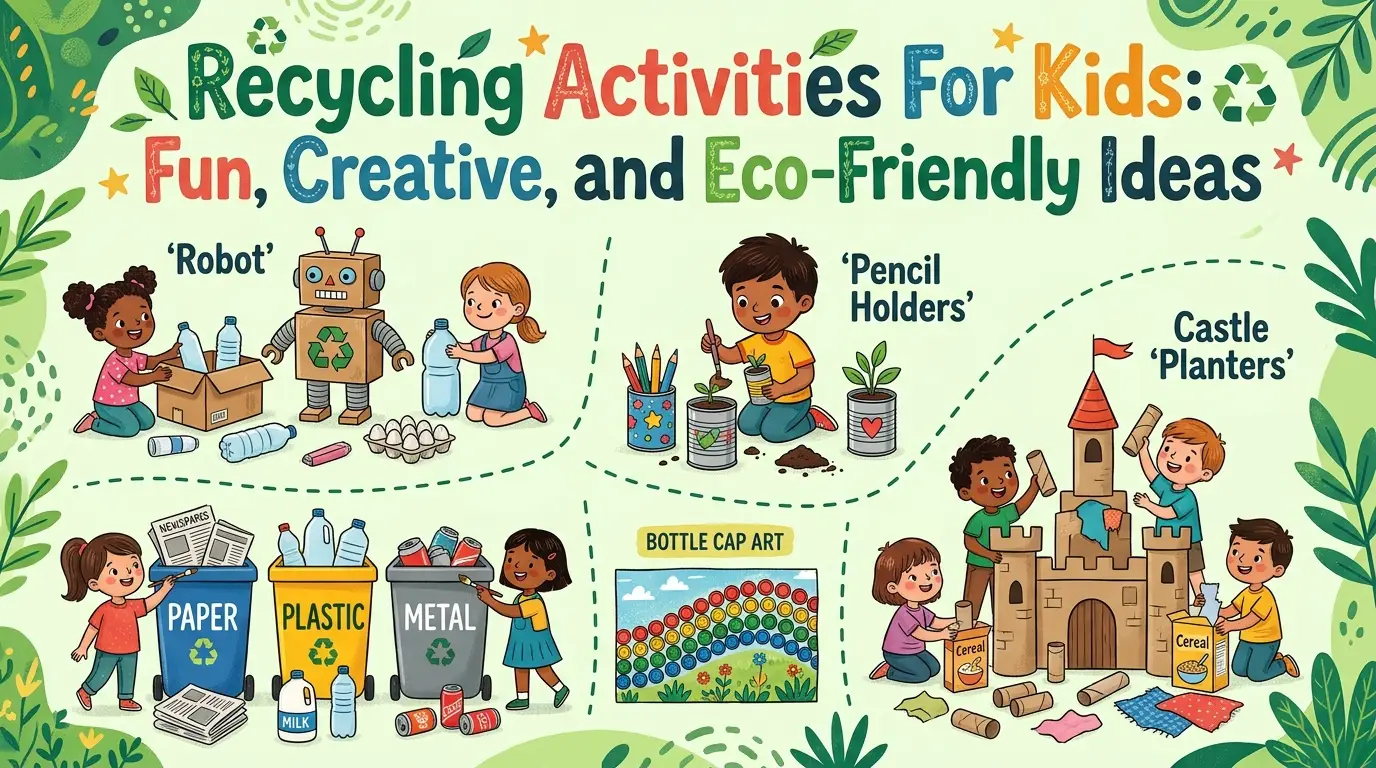
(“Recycling Sorting Game”) Create several labeled containers for paper, cardboard, plastic, glass, metal, and items that cannot be recycled locally. Give children clean household objects and let them decide where each item belongs. Talk about why each material belongs in its particular category.
(“Recycling Detective Hunt”) Turn recycling into a treasure hunt by asking children to search the house or classroom for recyclable materials. They can collect clean paper, boxes, cans, and containers before sorting their discoveries into appropriate groups.
(“Cardboard Castle”) Save large cardboard boxes and let children transform them into a castle. They can cut windows, create doors, decorate the walls, and use smaller boxes as towers. This recycling activity encourages imaginative play while giving old cardboard a second life.
(“Paper Collage”) Gather old magazines, newspapers, flyers, and unwanted paper. Children can tear or cut colorful pieces and arrange them into pictures, animals, landscapes, or abstract designs.
(“Recycled Robot”) Use empty boxes, cardboard tubes, bottle caps, clean containers, and other safe recyclable materials to create robots. Children can decide what their robots do and give each creation a unique name and personality.
(“Bottle Cap Art”) Save clean bottle caps and use them to make colorful pictures. Children can arrange the caps into flowers, animals, patterns, or letters before gluing them onto sturdy cardboard.
(“Newspaper Art”) Give children old newspapers and let them experiment with tearing, folding, rolling, and layering the paper. They can create flowers, animals, paper sculptures, or decorative wall art.
(“Cardboard Tube Animals”) Empty paper towel and toilet paper tubes can become playful animals. Children can add ears, wings, tails, eyes, and other features using scraps of cardboard and paper.
(“Recycled Bird Feeder”) Turn a suitable reused container into a simple bird feeder using child-safe materials and adult supervision. Place it somewhere visible and encourage children to observe visiting birds.
(“Recycled Planters”) Clean food containers can be decorated and reused as small planters. Children can add soil and grow herbs, flowers, or other suitable plants while learning about reuse and nature.
(“Tin Can Pencil Holder”) With adult help, clean and safely prepare an empty metal can. Children can decorate the outside with paper scraps, fabric pieces, or drawings and use it to organize pencils and crayons.
(“Cardboard Marble Run”) Save cardboard tubes and small pieces of cardboard to create a marble run. Children can experiment with different angles and arrangements to see how the marble moves.
(“Recycled Paper Making”) Teach children how used paper can become something new by creating handmade recycled paper with appropriate adult supervision. The activity introduces the basic idea of turning old materials into useful products.
(“Egg Carton Art”) Empty egg cartons can become flowers, insects, animals, or colorful sculptures. Children can cut and decorate the individual sections to create imaginative artwork.
(“Magazine Mosaic”) Cut colorful sections from old magazines and arrange them into mosaic-style pictures. Children can create patterns, landscapes, initials, or seasonal designs.
(“Recycled Crown”) Use leftover cardboard from packaging to make pretend crowns. Children can decorate their crowns with paper scraps, drawings, and other safe reusable craft materials.
(“Box Guitar”) A sturdy cardboard box and some stretched rubber bands can become a pretend guitar. Children can decorate the box and explore how changing the bands affects the sound.
(“Recycled Drum”) Clean containers with secure lids can be transformed into simple pretend drums. Children can decorate them and use safe household objects as drumsticks.
(“Paper Tube Binoculars”) Connect two cardboard tubes and decorate them as pretend binoculars. Children can use them during outdoor observation games.
(“Recycled Puzzle”) Draw a picture on a piece of unwanted cardboard, allow it to dry, and have an adult cut it into large puzzle pieces. Children can mix and rebuild their homemade puzzle.
(“Cardboard Letter Art”) Use discarded cardboard to cut out large letters. Children can decorate each letter with paper scraps, magazine pieces, or drawings.
Creative Recycling Activities For Preschoolers
(“Recycled Texture Board”) Create a texture board using safe clean materials such as cardboard, paper, and fabric scraps. Preschoolers can touch each section and describe whether it feels smooth, rough, soft, or bumpy.
(“Color Sorting With Recyclables”) Collect safe, clean recyclable objects in different colors. Ask children to group the objects by color before discussing what materials they are made from.
(“Paper Tearing Art”) Give preschoolers unwanted paper and allow them to tear it into different shapes. The pieces can then be arranged into a simple picture.
(“Cardboard Shape Matching”) Cut different shapes from old cardboard and create matching pairs. Children can match circles, squares, triangles, rectangles, and other basic shapes.
(“Recycled Shape Collage”) Use paper packaging and cardboard scraps to create a collage filled with different geometric shapes.
(“Container Bowling”) Clean lightweight containers can become indoor bowling pins. Arrange them in a row and let children gently roll a soft ball toward them.
(“Recycled Color Wheel”) Collect colorful pieces of old paper, packaging, and cardboard. Arrange them into a large color wheel to combine art with recycling education.
(“Paper Plate Animals”) Old clean paper plates can become animal faces. Children can add ears, eyes, noses, and other features using reusable craft scraps.
(“Cardboard Caterpillar”) Connect small cardboard circles or sections to create a caterpillar. Children can decorate each section differently.
(“Recycled Fish”) Use cardboard packaging to cut out fish shapes. Children can decorate their fish with colorful paper scraps and create an underwater display.
(“Egg Carton Caterpillar”) Children can paint or decorate sections of an egg carton and add simple features to make a cheerful caterpillar.
(“Recycled Nature Collage”) Combine safe fallen leaves and other natural materials with reused cardboard to create nature-inspired artwork.
(“Paper Chain”) Use strips of unwanted paper to make decorative paper chains. Children can learn how individual pieces can become something useful instead of being discarded.
(“Recycled Weather Wheel”) Use cardboard to create a rotating weather wheel. Children can decorate sections for sunny, rainy, cloudy, and windy weather.
(“Cardboard Sun”) Cut a large circle from discarded cardboard and add rays around the outside. Children can decorate the sun with reused paper.
Classroom Recycling Activities For Kids
(“Classroom Recycling Station”) Set up clearly labeled recycling containers in the classroom. Children can take turns helping classmates identify where clean recyclable materials belong.
(“Recycling Monitor”) Give students rotating responsibility for checking whether classroom recycling is being sorted correctly. This creates a sense of ownership and responsibility.
(“Waste Audit”) For a supervised classroom activity, collect a sample of the day’s waste and discuss what could potentially have been reused, recycled, or avoided. Follow local recycling guidance when identifying recyclable materials.
(“Recycling Poster Project”) Ask children to create posters explaining why recycling matters. They can use drawings, slogans, and pictures made from reused paper.
(“Recycling Rules Chart”) Work together to create a classroom chart showing simple recycling habits. Children can contribute illustrations and examples.
(“Recycling Story Writing”) Ask students to write a short story about a recyclable object traveling from a home to a recycling facility and becoming something new.
(“Recycling Vocabulary Game”) Introduce words such as reuse, recycle, reduce, waste, compost, paper, plastic, glass, and metal. Turn the vocabulary into a matching or guessing game.
(“Recycling Relay”) Divide students into teams and provide clean recyclable objects. One child at a time can carry an item to the correct labeled container.
(“Mystery Recycling Box”) Place a clean object inside a box and give children clues about its material. They can guess what it is and discuss whether it is recyclable.
(“Recycling Pledge Wall”) Invite students to write one recycling or waste-reduction promise on reused paper. Display the promises together as a classroom wall.
(“Recycled Bookmarks”) Use old cardboard or sturdy paper packaging to create bookmarks. Children can decorate them with environmental messages.
(“Recycling Quiz”) Create age-appropriate questions about recycling, reuse, and waste. Let children answer individually or in teams.
(“Recycled Classroom Decorations”) Create seasonal decorations from cardboard, newspapers, magazines, and other reusable materials rather than buying new decorations.
(“Packaging Investigation”) Examine clean product packaging and discuss the different materials used. Ask children why manufacturers might use cardboard, paper, metal, or plastic.
(“Recycling Role Play”) Let children pretend to be recyclers, sorting workers, environmental educators, or product designers. Role-playing helps make abstract ideas easier to understand.
Easy Recycling Activities At Home
(“Kitchen Recycling Challenge”) Give children a small basket and ask them to identify clean recyclable items from the kitchen. An adult can check each item before it goes into the recycling container.
(“Reuse Before Recycling Challenge”) Before throwing something away, ask children whether it could be reused. This teaches that reducing waste and reusing items can be important steps alongside recycling.
(“Recycled Gift Wrap”) Use old newspapers, paper bags, maps, or clean packaging paper to wrap small gifts. Children can decorate the wrapping with drawings.
(“Jar Decoration”) Clean glass jars can become decorative storage containers where appropriate. Children can decorate labels while adults handle any sharp lids or glass safely.
(“Recycled Storage Box”) Cover an old cardboard box with reused paper and turn it into a storage container for toys, books, or craft supplies.
(“Cereal Box Organizer”) Empty cereal boxes can be cut and decorated to create simple organizers for notebooks, papers, or lightweight supplies.
(“Paper Bag Puppet”) Reuse a clean paper bag to make a puppet. Children can draw faces and add features using scraps of paper.
(“Recycled Bookmark Set”) Cut sturdy packaging into bookmark shapes and decorate them with favorite colors, animals, or positive environmental messages.
(“Old Calendar Craft”) Pages from old calendars can be reused for artwork, gift tags, cards, and decorative projects.
(“Greeting Card Recycling”) Turn old greeting cards into gift tags or new craft decorations rather than immediately discarding them.
(“Recycled Memory Game”) Draw matching pictures on small pieces of cardboard to make a homemade memory game.
(“Paper Bead Craft”) With appropriate supervision, children can roll strips of unwanted paper into decorative beads and use them for craft projects.
(“Cardboard Building Blocks”) Cut sturdy cardboard into different shapes and allow children to build towers, houses, bridges, and other structures.
(“Recycled Puppet Theater”) A large cardboard box can become a small puppet theater. Children can decorate the front and create performances with homemade puppets.
(“Recycled Board Game”) Use cardboard to create a homemade board game. Children can invent the rules, design spaces, and create reusable game pieces.
Outdoor Recycling Activities For Kids
(“Park Clean-Up Walk”) With adults present, children can help collect safe litter in a local outdoor area while wearing appropriate protective equipment. Discuss why waste should be disposed of responsibly.
(“Recycling Scavenger Hunt”) Create a list of materials children might notice outdoors, such as cardboard, paper, metal cans, or plastic containers. The goal is observation and safe identification rather than touching unknown waste.
(“Nature And Recycling Walk”) Take a walk and talk about the difference between natural materials and manufactured waste. Children can learn that not everything found outdoors belongs in a recycling bin.
(“Recycled Garden Markers”) Reuse sturdy household materials to make labels for plants. Children can decorate the markers and learn the names of different plants.
(“Container Garden”) Repurpose suitable containers as plant pots. Make sure the container is appropriate for gardening and that children have adult help when using tools.
(“Recycled Wind Decoration”) Use lightweight reusable materials to create a simple outdoor decoration. Hang it safely where it will not create litter or endanger wildlife.
(“Cardboard Nature Frames”) Create cardboard frames from packaging and use them to frame interesting views during a nature walk.
(“Recycled Watering Can”) Repurpose an appropriate clean container into a simple watering tool, with an adult making any necessary holes.
(“Outdoor Sorting Station”) Set up a temporary sorting station during a supervised community activity and teach children how different collected materials should be handled.
(“Recycled Garden Art”) Create outdoor decorations from weather-appropriate reused materials. Children can design flowers, insects, signs, or colorful shapes.
Recycling Games For Kids
(“Recycling Bingo”) Make bingo cards featuring recyclable materials and environmental actions. Children mark a square when they identify or complete the activity.
(“Recycling Memory Match”) Create pairs of cards showing materials and matching recycling categories. Children turn over two cards at a time to find matches.
(“Guess The Material”) Show children an object and ask them to identify whether it is mainly paper, cardboard, metal, glass, plastic, or another material.
(“Recycling Charades”) Children can silently act out recycling-related actions such as sorting, reusing a box, carrying paper, or planting in a reused container.
(“Recycling Freeze Dance”) Play music while children dance. When the music stops, call out a recycling-related word and have them freeze in a pose representing it.
(“Sort It Fast”) Give children a collection of clean recyclable objects and challenge them to sort everything into the correct categories.
(“Recycling Treasure Hunt”) Hide safe reusable objects around a room and give children clues leading them to each item.
(“Reduce Reuse Recycle Race”) Call out one of the three actions and have children run to the corresponding sign. Use the game to explain the difference between reducing, reusing, and recycling.
(“Recycling Pictionary”) Children draw recycling-related objects while classmates try to guess what they are.
(“Recycling Word Search”) Create a word search featuring terms such as recycle, reuse, paper, plastic, glass, metal, waste, and environment.
Art And Craft Recycling Activities
(“Magazine Flower”) Roll or fold colorful magazine pages into petals and arrange them into decorative flowers.
(“Cardboard Picture Frame”) Cut a frame from cardboard packaging and decorate it with reused paper, buttons, or other safe craft materials.
(“Recycled City”) Use boxes, tubes, and cardboard scraps to build a miniature city. Children can add roads, buildings, parks, and signs.
(“Cardboard Rocket”) Turn a large cardboard tube or box into a pretend rocket. Children can decorate it and imagine traveling into space.
(“Recycled Airplane”) Use cardboard packaging to create a pretend airplane. Children can design wings, windows, and colorful patterns.
(“Paper Roll Flower”) Cut and shape cardboard tube sections into flower petals and arrange them into a craft display.
(“Recycled Monster”) Combine boxes, paper scraps, and cardboard pieces to make silly monsters. Encourage children to give each monster a funny personality.
(“Bottle Character”) Clean reusable containers can become characters with paper eyes, hair, hats, and clothing.
(“Recycled Butterfly”) Create butterfly wings from cardboard packaging and decorate them with colorful magazine scraps.
(“Cardboard Dinosaur”) Cut dinosaur shapes from cardboard and let children decorate them using reused paper.
(“Recycled Rainbow”) Arrange strips of old colorful paper into a rainbow. This simple project can also introduce color recognition.
(“Paper Scrap Artwork”) Keep a container of clean paper scraps and encourage children to use them whenever they want to create artwork.
(“Recycled Puppet”) Build simple puppets from cardboard, paper bags, or other safe reused materials.
(“Cardboard Train”) Use boxes and cardboard tubes to create a pretend train. Children can connect the cars and decorate each one differently.
(“Recycled Space Station”) Use clean boxes and packaging tubes to create a pretend space station where children can play and explore.
STEM Recycling Activities For Kids
(“Build A Recycled Bridge”) Give children cardboard pieces and ask them to design a bridge capable of holding lightweight objects. They can test different structures and make improvements.
(“Recycled Tower Challenge”) Children can build towers from cardboard tubes, boxes, and paper cups. Challenge them to make their structure tall while keeping it stable.
(“Material Strength Test”) Compare different types of reused paper and cardboard by observing which shapes hold weight best. Keep the experiment simple and supervised.
(“Recycled Boat Experiment”) Create small boats from suitable reused materials and test whether they float. Children can experiment with shape and balance.
(“Cardboard Maze”) Build a maze using cardboard strips and a small ball. Children can change the walls and experiment with different paths.
(“Recycled Marble Labyrinth”) Create a labyrinth from cardboard and test different marble paths. This encourages planning and problem-solving.
(“Packaging Engineering Challenge”) Give children several clean pieces of packaging and ask them to design a useful object.
(“Recycled Windmill”) Create a simple model windmill from reused cardboard and paper. Discuss how wind can cause movement.
(“Recycled Balance Challenge”) Use cardboard and other safe materials to build a simple balance structure. Children can explore how changing the placement of objects affects stability.
(“Reuse Design Challenge”) Ask children to choose one discarded household item and invent three different ways it could be reused.
Recycling Activities For Older Kids
(“Recycling Research Project”) Older children can choose one material and research how it is collected, processed, and turned into new products.
(“Local Recycling Guide”) Ask children to investigate the recycling rules in their community and create a simple guide for family members.
(“Waste Reduction Challenge”) Encourage children to track the types of waste their household produces for several days and identify realistic ways to reduce it.
(“Recycled Product Design”) Ask children to design a new product made partly from recycled materials. They can draw the product and explain its purpose.
(“Environmental Poster Campaign”) Children can design a collection of posters encouraging responsible waste habits at school or in their community.
(“Recycling Interview”) Have children interview a family member, teacher, or community worker about recycling habits and summarize what they learn.
(“Recycling Debate”) Divide students into groups and discuss questions about waste, reuse, recycling, and consumer choices. The focus should be on listening to different perspectives and supporting ideas with evidence.
(“Recycled Fashion Show”) Create wearable art from clean reusable materials such as cardboard, paper, and fabric scraps. Children can explain how their designs give materials another purpose.
(“Upcycled Sculpture”) Older children can create larger sculptures from clean packaging materials. Encourage planning before construction.
(“Recycling Awareness Video”) Children can make a short educational video explaining basic recycling habits. They can write a script, create visuals, and present the finished project.
Simple Recycling Activities For Family Time
(“Family Recycling Challenge”) Choose one day to see how many household items can be correctly reused, recycled, or avoided.
(“Recycling Craft Night”) Set aside an evening for the whole family to create something from clean reusable materials.
(“Family Sorting Contest”) Give family members the same collection of recyclable objects and see who can sort them correctly.
(“Recycled Movie Night Decorations”) Make simple decorations from old cardboard and paper before a family movie night.
(“Recycled Birthday Decorations”) Create banners, signs, and decorations from paper and cardboard that would otherwise be discarded.
(“Recycled Party Game”) Invent a family game using boxes, paper scraps, bottle caps, or other clean reusable materials.
(“Reuse Jar”) Keep a container filled with ideas for reusing household materials. Family members can add new ideas throughout the year.
(“Recycling Story Night”) Ask each family member to invent a story about an object that gets a second life instead of becoming waste.
(“Recycled Gift Project”) Encourage children to make a small handmade gift from safe reused materials.
(“Family Recycling Promise”) Create a family poster with simple environmental habits everyone agrees to practice.
Final Thoughts On Recycling Activities For Kids
Recycling activities for kids do more than provide something fun to do on a rainy afternoon. They help children understand that everyday objects have value beyond their first use. A box can become a building, paper can become artwork, a container can become a planter, and packaging can become part of an imaginative game.
The most effective recycling activities for kids are simple enough to understand but creative enough to encourage curiosity. You do not need expensive craft supplies or complicated equipment. Clean household materials, a little imagination, and some adult guidance can turn ordinary objects into memorable learning experiences.
As children practice sorting, reusing, creating, and reducing waste, recycling can become a natural part of their daily lives. Whether you are looking for classroom recycling activities, preschool recycling crafts, recycling games, STEM recycling projects, or family-friendly environmental activities, these ideas offer plenty of ways to make sustainability enjoyable.
The goal is not perfection. It is helping children understand that their choices matter and showing them that caring for the environment can be creative, practical, and fun.