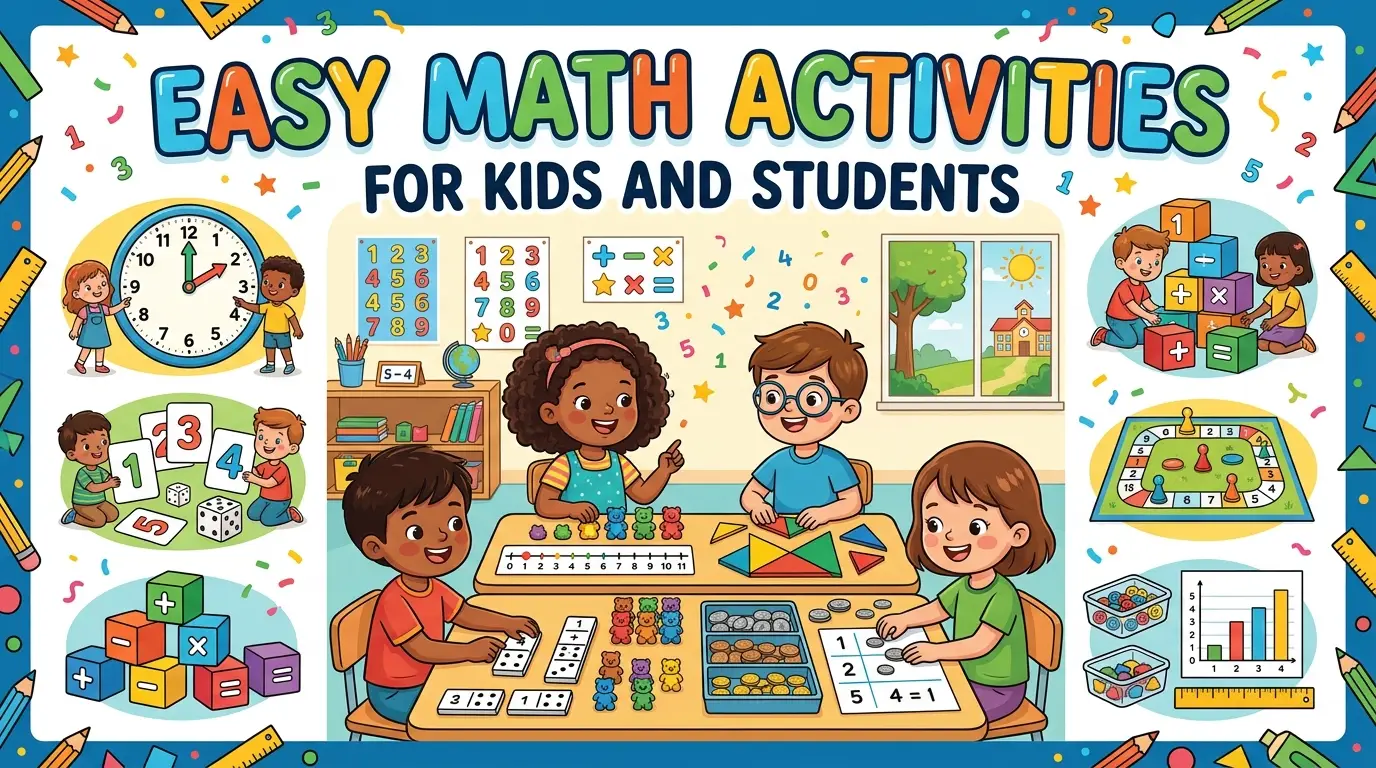
Easy Math Activities for Kids and Students
Math doesn’t have to feel like a stack of worksheets, endless equations, or a subject that only makes sense after hours of practice. With the right approach, math can become playful, practical, and surprisingly exciting. These 99 easy math activities are designed to make learning numbers, counting, addition, subtraction, multiplication, division, shapes, measurement, fractions, and problem-solving more enjoyable for children and students.
Whether you are a parent looking for easy math activities at home, a teacher planning classroom games, or a caregiver searching for screen-free learning ideas, these activities can turn everyday moments into valuable math practice. The best part? Many require little or no special equipment.
Easy Math Activities for Counting and Number Recognition
Count Everyday Objects
Turn counting into a simple scavenger hunt. Ask children to count toys, books, pencils, spoons, buttons, or anything else nearby. Encourage them to group objects into sets and compare which group contains more or fewer items. This easy math activity builds number recognition and counting confidence without making learning feel like formal schoolwork.
Number Hunt
Write numbers on small pieces of paper and hide them around a room. Give children a number range and ask them to find the hidden numbers in order. For an extra challenge, have them identify the number that comes immediately before and after each one.
Number of the Day
Choose one number each day and explore it in different ways. Children can write it, draw that many objects, find it on a clock, identify whether it is even or odd, and create simple addition or subtraction problems using it. This easy math activity encourages children to see numbers from multiple perspectives.
Count While Walking
Take math outdoors by counting steps between two locations. Children can predict how many steps they will need before walking and then compare their estimate with the actual number. This combines movement, counting, estimation, and observation.
Number Matching
Create cards containing numerals and cards containing groups of objects. Children match each numeral with the correct quantity. This is especially useful for young learners who are still connecting written numbers with actual quantities.
Easy Math Activities for Addition and Subtraction
Dice Addition
Roll two dice and ask children to add the numbers together. Write the equation after each roll. Once basic addition becomes comfortable, introduce three dice or ask children to find different combinations that produce the same answer.
Subtraction Race
Write several subtraction problems on cards. Children solve one card at a time and move a game piece forward whenever they answer correctly. The goal isn’t simply speed; encourage them to explain how they found each answer.
Snack Math
Use crackers, fruit pieces, cereal, or other snacks to create addition and subtraction problems. Ask questions such as, “If you have five pieces and eat two, how many are left?” Real objects make abstract math concepts easier to understand.
Make Ten
Give children numbers from zero through ten and challenge them to find pairs that add up to ten. This simple activity strengthens mental math and helps learners recognize useful number relationships.
Mystery Number
Think of a number between one and twenty. Give clues such as, “My number is greater than eight but less than twelve.” Children continue guessing until they find the mystery number. Increase the range as their skills improve.
Easy Math Activities for Multiplication and Division
Multiplication Arrays
Use coins, blocks, buttons, or cereal pieces to create rows and columns. Ask children to build arrays such as three rows of four objects and then write the related multiplication equation. This visual approach makes multiplication much easier to understand.
Skip-Counting Clap
Choose a multiplication table and clap while skip-counting. For example, children can clap while saying two, four, six, eight, and so on. Adding rhythm and movement can make multiplication facts easier to remember.
Times Table Toss
Write multiplication answers on paper plates or cards. Call out a multiplication problem and have children toss a soft ball toward the correct answer. This easy math activity adds physical movement to multiplication practice.
Equal Groups
Give children a collection of objects and ask them to divide them into equal groups. Discuss how many groups they made and how many objects are in each group. This naturally introduces the relationship between multiplication and division.
Classroom Store
Create a pretend store using toys or household objects. Give each item a price and ask children to calculate the cost of buying several identical items. Older learners can calculate totals, discounts, and change.
Easy Math Activities for Fractions
Fraction Pizza
Draw circles and divide them into equal sections. Color different sections to represent halves, thirds, quarters, or eighths. You can also use paper plates to create reusable fraction models.
Fraction Folding
Give children a sheet of paper and ask them to fold it into equal sections. Have them identify one-half, one-fourth, or one-eighth. Folding provides a hands-on way to visualize fractions.
Fraction Food
Use sandwiches, fruit, pancakes, or other foods to explore fractions. Ask questions like, “What fraction of the sandwich is left?” This makes fractions feel connected to everyday life.
Fraction Matching
Prepare cards showing fractions, pictures, and words. Children match equivalent representations. For example, a card showing one-half can be paired with a picture showing half of a shape.
Fraction Walk
Place fraction cards around a room. Call out a fraction and ask children to find its matching visual representation. This combines movement with fraction recognition.
Easy Math Activities for Shapes and Geometry
Shape Hunt
Ask children to find circles, squares, rectangles, triangles, and other shapes around the house or classroom. Windows, plates, books, signs, and toys can become part of the activity.
Build With Shapes
Give children paper shapes and challenge them to create houses, animals, vehicles, or abstract pictures. Ask them to identify the shapes they used and count how many of each shape appear in their creation.
Shape Sorting
Mix different shapes together and ask children to sort them according to their properties. They might group shapes by the number of sides, size, color, or whether they have curved edges.
Geometric Drawing
Use a ruler and pencil to create patterns from basic geometric shapes. Encourage children to describe their drawings using mathematical vocabulary such as line, angle, side, vertex, and symmetry.
Symmetry Challenge
Draw half of a simple picture and ask children to complete the other half symmetrically. Mirrors can also be used to demonstrate lines of symmetry.
Easy Math Activities Using Money
Pretend Shopping
Set up a pretend shop with household items and price tags. Give children play money and ask them to purchase items, calculate totals, and determine how much change they should receive.
Coin Sorting
Collect different coins and ask children to sort them by value, size, or type. Once they are familiar with individual coins, challenge them to create a specific amount using different combinations.
Price Guessing
Show children an everyday item and ask them to estimate its price. Discuss why they think the item costs that amount. This develops estimation and financial awareness.
Budget Challenge
Give children a pretend budget and a list of things they want to buy. Their goal is to stay within the budget while choosing as many useful items as possible.
Money Match
Write different monetary amounts on cards and ask children to build those amounts using coins or play money. This is an excellent way to practice practical math skills.
Easy Math Activities for Measurement
Measure the Room
Give children a measuring tape or ruler and ask them to measure furniture, books, doors, and other objects. Have them record their measurements and compare which objects are longer or shorter.
Estimate and Measure
Before measuring an object, ask children to guess its length. Then measure it and compare the estimate with the actual result. This builds estimation skills and mathematical reasoning.
Cooking Measurements
Cooking provides natural practice with cups, teaspoons, tablespoons, fractions, and quantities. Let children help measure ingredients while discussing why accurate measurements matter.
Height Chart
Create a simple height chart and measure family members or classmates. Record the measurements and compare who is taller or shorter.
Water Measurement
Give children different containers and ask them to predict which holds more water. Then use measuring cups to test their predictions. This activity introduces capacity in a memorable way.
Easy Math Activities With Patterns
Color Patterns
Create patterns using colored blocks, crayons, beads, or paper shapes. Ask children to identify the repeating rule and predict what comes next.
Number Patterns
Write a sequence such as 2, 4, 6, 8 and ask children to determine the rule. Then challenge them to create their own number patterns for someone else to solve.
Movement Patterns
Create patterns using movements such as clap, jump, clap, jump. Ask children to continue the sequence. This is particularly effective for younger learners because it combines physical activity with logical thinking.
Pattern Art
Encourage children to make repeating mathematical designs. They can use shapes, lines, numbers, or colors to create patterns while discussing the rule behind their design.
Missing Pattern
Create a sequence with one missing element and ask children to determine what belongs in the empty space. Start with simple repeating patterns and gradually introduce more complicated sequences.
Easy Math Activities for Time
Clock Practice
Use a toy clock or draw a clock face. Call out different times and ask children to show them using the hands. Reverse the activity by showing a time and asking children to identify it.
Daily Schedule Math
Use a daily routine to practice time. Ask questions such as, “If lunch starts at noon and lasts thirty minutes, when does it end?” This connects time skills with real-life situations.
Time Estimate
Ask children to estimate how long everyday activities will take. They can predict how long brushing their teeth, cleaning a room, or walking outside might take and then use a timer to check.
Elapsed Time Challenge
Give children a starting time and ending time and ask them to calculate how much time passed. Begin with simple intervals before introducing more challenging examples.
Calendar Math
Use a calendar to practice counting days, identifying weekdays, finding dates, and calculating how many days remain until an event.
Easy Math Activities for Problem-Solving
Math Story Problems
Create short stories involving everyday situations. For example, “There are six apples in a basket. Three more are added. How many apples are there now?” Encourage children to draw pictures or use objects to solve the problem.
What Doesn’t Belong?
Give children several numbers, shapes, or objects and ask which one doesn’t belong. The important part is asking them to explain their reasoning rather than simply choosing an answer.
Guess My Rule
Create a mathematical rule and provide examples. Children must figure out what the rule is. For example, numbers might be transformed by adding three. Once they understand the concept, let them create rules for others.
Math Detective
Give children a fictional mystery that requires several mathematical clues to solve. Each correct calculation reveals another clue. This turns ordinary math practice into an adventure.
Multiple Solutions
Give children a problem that can have more than one correct solution. For example, ask them to find different ways to make twenty using addition. This develops flexibility and creative mathematical thinking.
Easy Math Activities With Cards and Games
Higher or Lower
Choose a number and have children guess whether the next card will be higher or lower. This is a quick way to practice number comparison.
Math War
Use a deck of cards to create a simple comparison game. Each player turns over a card, and the person with the larger number wins the round. For advanced learners, use two cards to create addition or multiplication problems.
Equation Match
Create cards containing numbers, operation signs, and equal signs. Children arrange the cards to create correct equations. This encourages them to think about how mathematical expressions work.
Target Number
Choose a target number such as twenty-five. Give children several smaller numbers and challenge them to use addition, subtraction, multiplication, or division to reach the target.
Math Bingo
Create bingo cards containing numbers or answers. Call out mathematical problems, and children mark the corresponding answers. This can be adapted for almost any grade level.
Easy Math Activities for Learning at Home
Math Treasure Hunt
Hide objects around the house and provide mathematical clues. A clue might tell children to move five steps forward, find the third book on a shelf, or locate an object shaped like a rectangle.
Laundry Math
Ask children to sort socks by pairs, count clothing items, or compare piles. Sorting and counting ordinary laundry can become a surprisingly useful early math activity.
Grocery Store Math
When shopping, ask children to compare prices, count items, estimate totals, or determine which product is cheaper. These practical questions show children why math matters beyond the classroom.
Staircase Counting
Count stairs while walking up or down. Older children can multiply the number of stairs per section or calculate totals across multiple trips.
Room Measurement Challenge
Ask children to estimate the dimensions of a room and then measure it. Discuss the difference between their estimate and the actual measurement.
Easy Math Activities for Classroom Learning
Math Stations
Create several stations around the classroom, each focusing on a different skill. One station might involve addition, another shapes, another measurement, and another puzzles. Students rotate between stations and learn through variety.
Human Number Line
Ask students to stand in order according to numbers assigned to them. Once they understand the basic idea, introduce fractions, negative numbers, or decimals for more advanced practice.
Math Partner Challenge
Pair students and give them a problem to solve together. Require both partners to explain the strategy they used. This encourages communication as well as mathematical understanding.
Whiteboard Race
Write several problems on a board and let students solve them individually or in teams. Focus on accuracy and reasoning rather than simply rewarding the fastest student.
Create Your Own Problem
Ask students to invent a math problem that another student can solve. This requires them to understand the mathematical concept deeply enough to construct a meaningful question.
Easy Math Activities for Critical Thinking
Number Riddles
Create riddles based on mathematical properties. For example, a number might be even, greater than ten, and divisible by three. Children use the clues to determine the answer.
Which Is Greater?
Give students two fractions, decimals, measurements, or numbers and ask them to determine which is greater. Encourage them to explain their reasoning using pictures or mathematical language.
Find the Mistake
Show an incorrect solution and ask children to identify the mistake. This teaches them that errors are useful opportunities for learning and encourages careful thinking.
Math Puzzles
Use crossword-style math puzzles, Sudoku, logic grids, or number challenges. These activities strengthen reasoning and persistence while keeping practice interesting.
Explain Your Answer
After solving a problem, ask children to explain how they reached the answer. Two students may use different strategies and still arrive at the same correct result.
Easy Math Activities for Outdoor Learning
Nature Counting
Collect leaves, stones, sticks, or other safe natural objects and count or sort them. Children can create groups and compare quantities.
Outdoor Shape Hunt
Look for geometric shapes in buildings, signs, playground equipment, windows, and natural objects. Ask children to photograph or sketch the shapes they discover.
Step Measurement
Estimate and measure distances using footsteps. Children can compare the results of different people’s steps and discuss why measurements vary.
Angle Hunt
Look for angles in playground equipment, buildings, fences, and other structures. Ask children whether they can identify right, acute, and obtuse angles.
Outdoor Data Collection
Collect simple information such as the number of different types of leaves found or the number of cars of different colors passing a safe observation point. Turn the results into a basic chart or graph.
Easy Math Activities With Technology
Digital Number Games
Use age-appropriate educational math games to practice counting, arithmetic, patterns, and problem-solving. Keep sessions focused and use digital games as a supplement rather than the only form of practice.
Virtual Math Quiz
Create a short quiz using digital tools and let children answer questions independently. Include a mixture of easy and challenging questions to keep the experience balanced.
Digital Graphing
Collect simple data and enter it into a basic spreadsheet or graphing tool. Children can observe how numbers become visual information.
Online Shape Drawing
Use a drawing application to create geometric shapes. Ask children to identify sides, corners, symmetry, and other properties.
Math Video Challenge
Watch a short educational math video and then ask children to solve a few related problems without looking at the answers. This turns passive viewing into active learning.
Easy Math Activities for Different Learning Levels
Preschool Math Activities
For preschoolers, focus on counting, sorting, matching, shapes, colors, and simple comparisons. Keep activities short and hands-on. At this stage, playing with numbers is often more valuable than completing long worksheets.
Elementary Math Activities
Elementary learners can practice addition, subtraction, multiplication, division, fractions, measurement, money, geometry, and basic problem-solving. Games and real-world activities can reinforce skills introduced at school.
Middle School Math Activities
Older students can explore percentages, ratios, decimals, algebraic thinking, geometry, probability, and data analysis through practical challenges. Real-world scenarios often make abstract concepts easier to understand.
Family Math Activities
Math activities do not need to feel like homework. Families can cook together, compare prices, play card games, estimate travel time, or solve puzzles. These everyday experiences provide natural opportunities to practice mathematical thinking.
Why Easy Math Activities Make Learning More Effective
The strongest math learning doesn’t always happen when students sit quietly and complete page after page of problems. Hands-on activities allow learners to see, touch, discuss, move, and experiment with mathematical ideas.
Easy math activities also give children opportunities to make mistakes without feeling that every error is a failure. When math becomes a game or challenge, students are often more willing to try again, change their strategy, and discover why an answer works.
Another advantage is flexibility. A single activity can usually be adjusted for different ages. A young child might use counting objects, while an older student could use the same objects to explore multiplication, fractions, ratios, or probability.
How to Make Easy Math Activities More Fun
The key is variety. Avoid using the same activity every day. Mix movement-based games with quiet puzzles, outdoor challenges with household activities, and individual practice with partner games.
Keep instructions simple and allow children to discover solutions rather than immediately giving them the answer. Ask questions such as, “How did you figure that out?” or “Can you find another way?”
Most importantly, celebrate effort and reasoning. A child who struggles with a problem but keeps experimenting is developing an important mathematical habit: persistence.
Final Thoughts on Easy Math Activities
These easy math activities show that mathematics can happen almost anywhere. A kitchen can become a measurement lab, a grocery store can become a budgeting lesson, a playground can become a geometry classroom, and a deck of cards can become a multiplication game.
The goal isn’t to make every activity complicated or perfectly structured. The goal is to create more opportunities for children and students to interact with numbers in meaningful ways. When math feels connected to real life, curiosity often follows naturally.
Whether you are looking for easy math activities for kids, classroom math games, math activities at home, hands-on math practice, or creative ways to teach basic math skills, start with a few activities that match the learner’s interests. Keep them playful, encourage questions, and gradually increase the challenge.
Sometimes the simplest math activity can spark the biggest “aha!” moment.