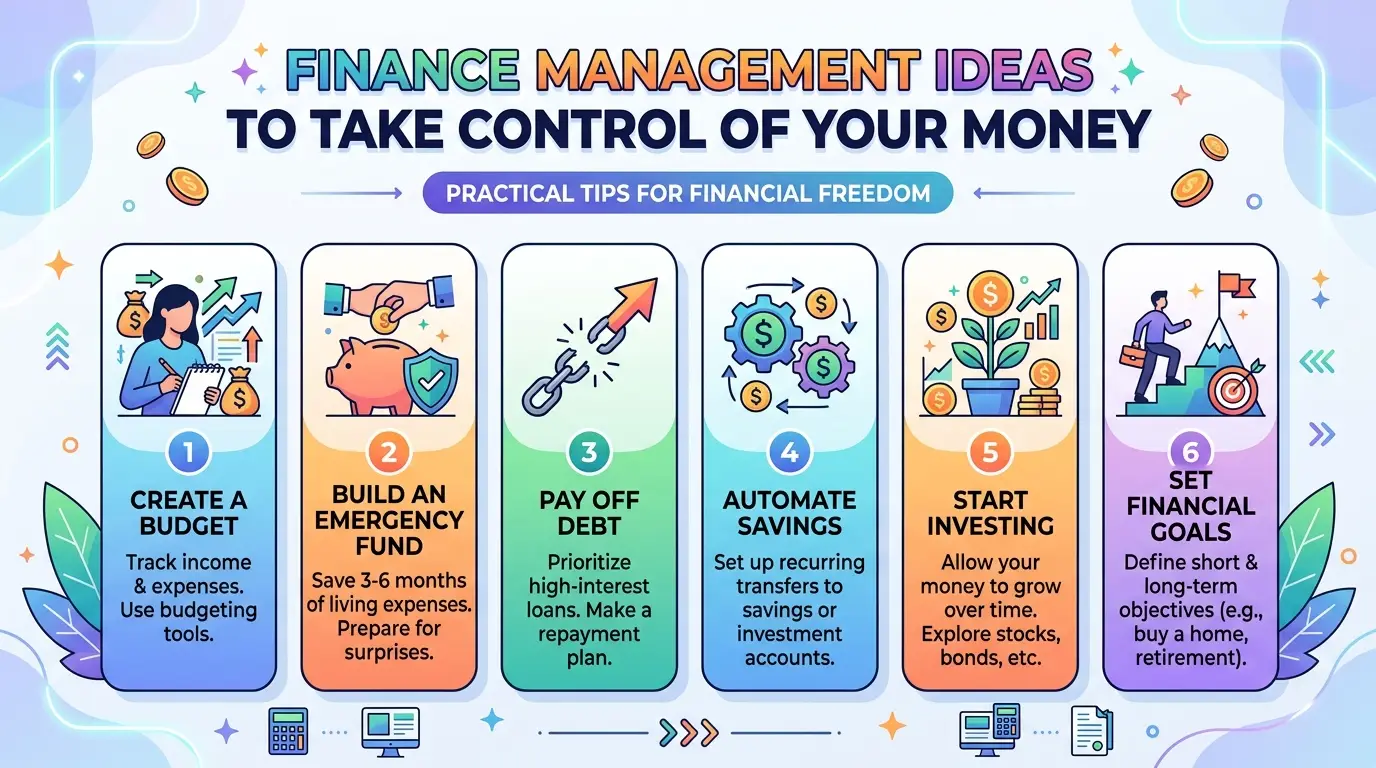
Finance Management Ideas to Take Control of Your Money
Managing money well isn’t just about earning more. It’s about knowing where your money goes, making thoughtful decisions, preparing for unexpected expenses, and building habits that support the life you actually want. Good finance management can reduce stress, improve financial confidence, and help you make better choices with every paycheck.
Whether you’re a student, employee, freelancer, entrepreneur, parent, or someone trying to get out of debt, learning effective 129 finance management strategies can make a meaningful difference. You don’t have to become a financial expert overnight. Small improvements, repeated consistently, can completely change your financial situation over time.
As the saying goes, “A strong financial future is built through small decisions made consistently.”
What Is Finance Management?
Finance management is the process of planning, organizing, controlling, and monitoring your money. It includes budgeting, saving, investing, managing debt, controlling expenses, preparing for emergencies, and planning for long-term financial goals.
Effective personal finance management gives every dollar a purpose. Instead of wondering where your income disappeared at the end of the month, you begin making intentional decisions before spending occurs.
The goal isn’t necessarily to spend as little as possible. The real goal is to spend wisely while protecting your financial future.
Why Finance Management Matters
Good finance management can give you something that money alone cannot buy: peace of mind.
When your finances are organized, unexpected expenses become easier to handle. You can make purchases without constantly worrying about your bank balance. You can work toward major goals such as buying a home, starting a business, traveling, or retiring comfortably.
Poor money management, on the other hand, can create a cycle of overspending, debt, missed payments, and financial anxiety.
The good news? Financial habits can be changed.
Create a Realistic Monthly Budget
Start by creating a monthly budget based on your actual income and expenses. Include rent, utilities, groceries, transportation, subscriptions, debt payments, savings, entertainment, and other regular costs.
A realistic budget should reflect your lifestyle rather than an imaginary version of it.
Track Every Expense
Expense tracking is one of the simplest finance management habits you can develop. Record even small purchases because little expenses can quietly become large monthly totals.
Review your spending regularly and look for patterns.
You may discover that the biggest problem isn’t one expensive purchase. It may be dozens of small purchases happening automatically.
Separate Needs From Wants
Before spending money, ask yourself whether something is a genuine need or simply a want.
Needs usually include essentials such as housing, food, transportation, healthcare, and basic utilities. Wants can include entertainment, luxury items, frequent restaurant meals, and impulse purchases.
This distinction doesn’t mean you should eliminate everything enjoyable. It simply helps you decide what deserves priority.
Set Specific Financial Goals
Financial goals become easier to achieve when they’re specific.
Instead of saying, “I want to save money,” decide exactly what you’re saving for and how much you need.
You might create goals for an emergency fund, vacation, education, a vehicle, a home, retirement, or starting a business.
Give every major financial goal a target amount and deadline.
Build an Emergency Fund
An emergency fund is one of the most important foundations of personal finance management.
Unexpected car repairs, medical costs, job changes, household problems, or urgent travel can happen without warning. An emergency fund gives you a financial cushion so you don’t have to immediately rely on credit cards or high-interest loans.
Start small if necessary. Even a modest emergency fund is better than having nothing saved.
Automate Your Savings
Automation makes saving easier because it removes the need to remember every month.
Set up an automatic transfer from your checking account to a dedicated savings account after receiving your income.
When saving happens automatically, you’re less likely to spend the money first.
Pay Yourself First
Treat savings like a bill that must be paid.
Instead of spending your income and saving whatever remains, save a predetermined amount first and organize your remaining money around your priorities.
This simple change can transform your savings habits.
Avoid Lifestyle Inflation
Lifestyle inflation happens when your spending increases every time your income increases.
Getting a raise is exciting, but immediately upgrading your car, apartment, phone, wardrobe, and entertainment can prevent you from becoming financially stronger.
When your income grows, consider directing part of the increase toward savings, investments, and debt reduction.
Create a Debt Repayment Strategy
Debt management is a major part of finance management.
List your debts, interest rates, minimum payments, and balances. Then choose a repayment approach that fits your situation.
Two popular approaches are the debt snowball method and the debt avalanche method.
The snowball method focuses on paying the smallest balance first, while the avalanche method prioritizes the debt with the highest interest rate.
Pay Bills on Time
Late payments can result in fees, penalties, and potential damage to your credit history.
Create a bill calendar or automate recurring payments whenever possible.
A simple reminder system can prevent avoidable financial problems.
Review Your Subscriptions
Subscription expenses are easy to forget because they often leave your account automatically.
Review streaming services, apps, memberships, cloud storage, software subscriptions, and other recurring charges.
Cancel services you rarely use.
Reduce Unnecessary Fees
Bank fees, late charges, overdraft fees, and service costs can slowly drain your finances.
Review your accounts and identify avoidable charges.
Sometimes a small administrative change can save money repeatedly.
Shop With a List
Shopping without a plan can encourage impulse purchases.
Create a list before grocery shopping or buying household items, and try to stick to it.
A list gives your spending boundaries before you enter the store.
Compare Prices Before Buying
Don’t automatically purchase the first option you see.
Compare prices, quality, warranties, reviews, and long-term value before making significant purchases.
The cheapest product isn’t always the best deal, but the most expensive one isn’t automatically the best either.
Use the 24-Hour Rule
For nonessential purchases, consider waiting 24 hours before buying.
This gives you time to determine whether you genuinely want the item or simply experienced a moment of excitement.
For expensive purchases, consider waiting even longer.
Avoid Emotional Spending
People sometimes spend money when they’re bored, stressed, lonely, frustrated, or celebrating.
Recognizing emotional spending triggers is an important finance management skill.
Before making an unnecessary purchase, ask yourself, “Would I still want this tomorrow?”
Build a Financial Calendar
A financial calendar can help you organize bill due dates, subscription renewals, insurance payments, tax deadlines, savings transfers, and financial reviews.
Knowing what’s coming makes your finances easier to manage.
Keep Separate Accounts for Different Goals
Consider using separate accounts for everyday spending, emergency savings, short-term goals, and long-term savings.
Separating money can make your financial priorities more visible and reduce accidental spending.
Review Your Bank Statements
Don’t assume every transaction is correct.
Review your bank and credit card statements regularly. Look for unexpected charges, duplicate transactions, forgotten subscriptions, and unusual activity.
Regular reviews also help you understand your actual spending behavior.
Protect Your Financial Information
Good finance management also involves financial security.
Use strong passwords, enable two-factor authentication where available, avoid sharing sensitive banking information, and monitor your accounts for unusual activity.
Your financial plan is only useful if your money is protected.
Improve Your Financial Literacy
Financial literacy makes better money management possible.
Learn the basics of budgeting, interest, inflation, investing, taxes, insurance, credit, retirement planning, and debt.
You don’t need to understand everything immediately. Make learning a long-term habit.
Understand Compound Growth
Compound growth can become a powerful financial tool over long periods.
When returns generate additional returns, your money can grow increasingly faster over time.
This is one reason starting to save and invest early can be valuable.
Start Investing Carefully
Investing can help build long-term wealth, but investments involve risk.
Before investing, understand what you’re buying, why you’re buying it, how long you plan to hold it, and how much risk you can tolerate.
Don’t invest money you may need immediately for essential expenses.
Diversify Your Investments
Diversification means spreading investments across different assets rather than depending heavily on one investment.
The objective is to avoid having your entire financial future tied to the performance of a single asset.
Think Long Term
Successful finance management requires patience.
Markets move up and down. Expenses change. Careers evolve. Life creates surprises.
Avoid making major financial decisions solely because of short-term excitement or fear.
Prepare for Large Expenses
Large expenses shouldn’t always be treated as emergencies.
If you know you’ll eventually need a new laptop, vehicle, education, home repair, insurance payment, or annual bill, start saving before the expense arrives.
Create sinking funds for predictable future expenses.
Practice Delayed Gratification
Delayed gratification means choosing a future benefit over an immediate pleasure.
You might skip an unnecessary purchase today so you can build savings, reduce debt, or reach a larger financial goal tomorrow.
This habit can be surprisingly powerful.
Be Careful With Credit Cards
Credit cards can be useful financial tools when managed responsibly.
However, carrying high-interest balances can become expensive.
Try to understand interest rates, fees, minimum payments, billing cycles, and rewards before using a credit card extensively.
Don’t Depend on Minimum Payments
Paying only the minimum amount on debt can keep balances around for a long time.
Whenever financially possible, paying more than the minimum can reduce interest costs and accelerate repayment.
Maintain Good Credit Habits
Pay bills on time, keep credit usage manageable, monitor your credit reports, and avoid applying for unnecessary credit.
A strong credit profile can be useful when applying for loans, housing, or other financial services.
Plan for Retirement Early
Retirement planning shouldn’t wait until you’re close to retirement age.
The earlier you begin thinking about long-term financial security, the more time you have to save and potentially benefit from compound growth.
Even small contributions can become meaningful over decades.
Increase Your Income
Finance management isn’t only about cutting expenses.
Look for opportunities to increase income through skill development, career advancement, freelancing, consulting, entrepreneurship, or other legitimate income sources.
Increasing income can give your financial plan more flexibility.
Invest in Valuable Skills
Skills can become financial assets.
Learning technology, communication, sales, writing, leadership, analysis, design, or other valuable skills may improve your earning potential.
Sometimes the best financial investment is an investment in yourself.
Create a Side Income Carefully
A side income can accelerate savings or debt repayment.
However, don’t sacrifice your health, primary employment, or essential responsibilities for a side hustle that produces little value.
Choose opportunities that match your skills, time, and realistic earning potential.
Review Your Financial Progress Monthly
Set aside time every month for a personal finance review.
Check your income, spending, savings, debt balances, investments, and progress toward goals.
A monthly review turns finance management into an ongoing habit rather than a once-a-year activity.
Have a Weekly Money Check-In
You don’t need to spend hours reviewing finances.
A quick weekly check can show whether you’re staying within your spending limits and whether upcoming expenses require attention.
Ten minutes of awareness can prevent hours of financial stress later.
Set Spending Limits
Create reasonable spending limits for categories such as dining, entertainment, shopping, transportation, and hobbies.
These limits don’t have to be extremely restrictive.
They simply create boundaries.
Make Your Budget Flexible
A budget shouldn’t make you feel trapped.
Unexpected expenses and special occasions happen. Give yourself some flexibility while maintaining your overall financial priorities.
A flexible budget is often easier to maintain than an unrealistic one.
Use Cash Strategically
Some people find that using cash for certain categories makes spending more noticeable.
You can establish a specific cash amount for discretionary expenses and stop spending once that amount is gone.
Reduce Food Waste
Food waste is both financially and environmentally costly.
Plan meals, use leftovers, store food properly, and buy quantities you realistically expect to consume.
Small improvements in grocery management can produce meaningful savings over a year.
Cook More Often
Eating at home is often less expensive than regularly buying restaurant meals or delivery.
You don’t have to cook elaborate meals. Simple, repeatable recipes can make home cooking practical.
Plan Transportation Costs
Transportation can represent a significant portion of a household budget.
Consider fuel, maintenance, insurance, parking, public transportation, and vehicle payments when evaluating transportation choices.
Review Insurance Coverage
Insurance is an important part of financial protection.
Review your coverage periodically to make sure it still fits your circumstances. Avoid being underinsured, but also check whether you’re paying for unnecessary coverage.
Create a Net Worth Statement
Your net worth provides a broader view of your financial health.
It represents what you own minus what you owe.
Tracking net worth over time can show whether your overall financial position is improving.
Don’t Compare Your Finances With Others
Social media can make other people’s lifestyles look effortless.
Remember that you rarely see their debts, obligations, financial support, or private struggles.
Focus on your own financial goals.
Practice Intentional Spending
Intentional spending means deciding in advance what deserves your money.
You don’t have to eliminate enjoyable purchases. Instead, spend more confidently on things that genuinely matter to you and reduce spending on things that don’t.
Build a Money Mindset
Your financial habits are influenced by your beliefs about money.
Ask yourself what you learned about spending, saving, debt, and wealth while growing up.
Understanding your financial mindset can help you identify habits that no longer serve you.
Teach Children About Money
Financial education can begin early.
Teach children simple concepts such as saving, spending, earning, sharing, budgeting, and delayed gratification.
Early financial lessons can become valuable lifelong habits.
Have Financial Conversations With Your Partner
Money can become a source of conflict when couples avoid discussing it.
Talk openly about income, expenses, debt, savings, financial goals, and expectations.
The goal isn’t perfect agreement. It’s shared understanding.
Prepare for Financial Emergencies
Emergency planning should go beyond savings.
Keep important documents organized, understand your insurance coverage, maintain essential contact information, and know which expenses could be reduced if income suddenly changed.
Avoid Get-Rich-Quick Promises
Be skeptical of financial opportunities promising guaranteed extraordinary returns with little or no risk.
Real wealth generally requires time, discipline, knowledge, and appropriate risk management.
Research Before Making Major Financial Decisions
Before taking a major loan, buying an investment, opening an account, or making a significant purchase, do your research.
Understand the costs, risks, alternatives, and long-term consequences.
Make Financial Management a Habit
The most effective finance management system is one you can actually maintain.
You don’t need a complicated spreadsheet or dozens of financial apps.
A simple system that you consistently follow can outperform a sophisticated system you abandon after two weeks.
129 Finance Management Ideas to Apply
Use these practical finance management ideas as a checklist for improving your financial life:
Create a monthly budget.
Track daily expenses.
Set weekly spending limits.
Separate needs from wants.
Automate savings.
Build an emergency fund.
Create sinking funds.
Pay bills before their due dates.
Review subscriptions.
Cancel unused memberships.
Compare prices.
Use shopping lists.
Avoid impulse purchases.
Practice delayed gratification.
Set short-term financial goals.
Set long-term financial goals.
Create a debt repayment plan.
Prioritize high-interest debt.
Avoid unnecessary borrowing.
Pay more than minimum debt payments when possible.
Monitor credit activity.
Review bank statements.
Check recurring charges.
Reduce banking fees.
Plan for annual expenses.
Prepare for unexpected costs.
Cook meals at home.
Reduce food waste.
Plan grocery purchases.
Compare insurance options.
Review transportation costs.
Reduce unnecessary commuting expenses.
Consider affordable transportation alternatives.
Track household utilities.
Reduce unnecessary energy consumption.
Avoid lifestyle inflation.
Save part of every income increase.
Increase your earning potential.
Learn valuable skills.
Explore suitable side-income opportunities.
Negotiate compensation when appropriate.
Build an emergency reserve.
Keep savings accessible for emergencies.
Separate savings from everyday spending.
Create financial milestones.
Calculate your net worth.
Review your net worth periodically.
Learn basic investing principles.
Understand investment risk.
Diversify investments appropriately.
Think long term.
Avoid emotional investing.
Understand fees before investing.
Research financial products carefully.
Learn about compound growth.
Start retirement planning early.
Increase retirement contributions when possible.
Review retirement progress.
Create a financial calendar.
Schedule monthly money reviews.
Have weekly financial check-ins.
Automate recurring payments.
Automate savings contributions.
Use reminders for financial deadlines.
Organize financial documents.
Protect account passwords.
Enable two-factor authentication.
Monitor accounts for suspicious activity.
Avoid sharing sensitive financial information.
Learn about taxes.
Keep appropriate financial records.
Understand loan terms.
Compare interest rates.
Understand credit card fees.
Avoid carrying unnecessary high-interest balances.
Use credit responsibly.
Avoid unnecessary credit applications.
Review your credit information.
Plan major purchases.
Research expensive purchases before buying.
Compare total ownership costs.
Buy based on value rather than status.
Repair items when practical.
Avoid unnecessary upgrades.
Create a personal spending philosophy.
Identify emotional spending triggers.
Find alternatives to stress spending.
Give yourself a reasonable fun budget.
Celebrate financial milestones.
Don’t let budgeting remove all enjoyment.
Avoid comparing lifestyles.
Focus on personal financial progress.
Discuss money openly with your partner.
Teach children basic money skills.
Set household financial goals.
Review financial goals after major life changes.
Prepare for career changes.
Maintain useful professional skills.
Build multiple sources of financial resilience.
Avoid suspicious investment opportunities.
Question unrealistic financial promises.
Research before signing financial contracts.
Understand the long-term cost of debt.
Avoid unnecessary late fees.
Plan for predictable large expenses.
Review financial priorities each year.
Update your budget when income changes.
Adjust your savings strategy when circumstances change.
Reduce expenses that provide little value.
Spend more intentionally on what matters.
Learn from financial mistakes.
Don’t let one mistake define your financial future.
Focus on consistency rather than perfection.
Create systems that make good financial habits easier.
Use financial tools responsibly.
Keep financial goals visible.
Review progress regularly.
Reward yourself responsibly for reaching milestones.
Build financial confidence through education.
Understand that financial progress takes time.
Stay patient during setbacks.
Keep an emergency plan.
Maintain appropriate financial protection.
Think about your future self when spending today.
Make financial decisions based on your priorities.
Review your overall financial health every year.
Continue improving your financial knowledge.
How to Make Finance Management Easier
The biggest mistake people make with finance management is trying to change everything at once.
You don’t need to suddenly stop spending, save half your income, eliminate every subscription, and become an investment expert.
Start with a few high-impact habits.
Track your spending. Create a basic budget. Build an emergency fund. Reduce expensive debt. Automate savings. Then gradually improve the system.
Think of personal finance like physical fitness. One workout won’t transform your body, and one good financial decision won’t transform your finances. Consistency is what creates the result.
Common Finance Management Mistakes to Avoid
One common mistake is ignoring small expenses. Small purchases can become significant when repeated.
Another mistake is creating a budget that is so restrictive that you abandon it after a few weeks.
Ignoring debt interest is another costly error. A debt balance isn’t just about the amount borrowed; interest and fees can dramatically affect the final cost.
Many people also fail to prepare for irregular expenses. Annual bills, repairs, gifts, travel, and maintenance shouldn’t always come as surprises.
Finally, don’t confuse financial appearance with financial health. A person driving an expensive car may not necessarily be financially secure, while someone living modestly may have substantial savings and investments.
Final Thoughts on Finance Management
Effective finance management isn’t about becoming obsessed with every dollar. It’s about creating enough structure and awareness to make confident financial decisions.
Your financial journey will have good months and difficult months. You may make mistakes. Unexpected expenses may appear. Income may change. Plans may need to be adjusted.
That’s normal.
What matters is having a system that helps you recover, learn, and keep moving forward.
Start with one financial habit today. Track your expenses. Create a savings goal. Review your subscriptions. Make a debt payment. Automate a transfer. Learn something new about money.
Then repeat it tomorrow.
As the saying goes, “Financial freedom isn’t created by one perfect decision; it’s created by hundreds of better decisions made over time.”
Good finance management gives your money direction, but more importantly, it gives your future a stronger foundation.